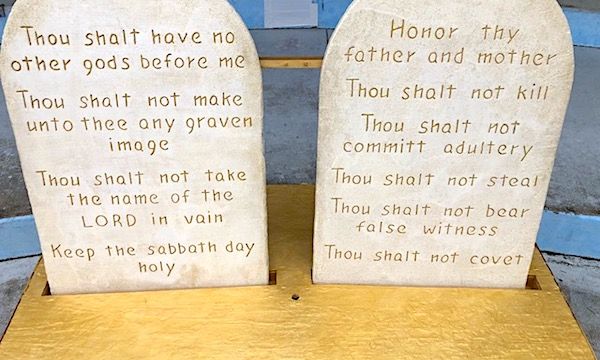
It’s because, supporters say, the Ten Commandments are part of America’s historical and moral heritage that they should be displayed in classrooms.
So Texas lawmakers wrote a law providing that the moral instructions be posted, and visible, in schools.
They suggest that’s one way to honor the foundational ideals of U.S. law and history.
And now a federal appeals court has upheld that plan.
It is Texas Senate Bill 10 that was adopted in 2025 and signed by Gov. Greg Abbott that calls for a display of the rules, at least 16 inches by 20 inches, to be put in a “conspicuous” location.
The American Civil Liberties Union and the anti-faith Americans United for Separation of Church and State, and others, sued claiming it violated the First Amendment and the Free Exercise Clause.
The 5th U.S. Circuit Court of Appeals rejected those ideas.
In a 9-8 decision the court found the law does not tell churches or synagogues or mosques what to believe or how to worship, it punishes no one, it does not require religious teaching, and more.
According to CBS, the ruling found the Ten Commandments displays are not “engines of coercive indoctrination.”
The judges said, “S.B. 10 … does not tell churches or synagogues or mosques what to believe or how to worship or whom to employ as priests, rabbis, or imams. It punishes no one who rejects the Ten Commandments, no matter the reason. It levies no taxes to support any clergy. It does not co-opt churches to perform civic functions. These are the kinds of things ‘establishments of religion’ did at the founding. S.B. 10 does none of them.”
Those complaining said they didn’t “want their children to be forced to observe and venerate a state-mandated version of the Ten Commandments each school day, in violation of their religious freedom.”
The court’s ruling said it doesn’t.
“Students are neither catechized on the Commandments nor taught to adopt them,” the court said. “Nor are teachers commanded to proselytize students who ask about the displays or contradict students who disagree with them. Most importantly, the ‘coercion’ characteristic of religious establishments was government pressure to engage in religious worship. That’s why establishments prescribed liturgies and punished those who skipped them. S.B. 10 is far from that. It puts a poster on a classroom wall. Yes, Plaintiffs have sincere religious disagreements with its content. But that does not transform the poster into a summons to prayer.”
🚨WIN: This is a major victory for Texas and our moral values. My office was proud to defend SB 10 and successfully ensure that the Ten Commandments will be displayed in classrooms across Texas.
The Ten Commandments have had a profound impact on our nation, and it’s important… https://t.co/6sh3uLnFpI
— Attorney General Ken Paxton (@KenPaxtonTX) April 21, 2026
🚨 GREAT NEWS: A federal appeals court has UPHELD a Texas law which requires public schools to display posters of the Ten Commandments in classrooms
BIG win by AG @KenPaxtonTX!🔥
Other states such as Arkansas and Louisiana have passed similar laws
America is a Christian nation… pic.twitter.com/EXDPPrtL1s
— Nick Sortor (@nicksortor) April 22, 2026
Way to go Texas! Every public classroom in the state will have the Ten Commandments displayed according to yesterday’s ruling. Our laws spring from the Ten Commandments, and this change will give young people a chance to read and know them. Of course, secularist groups already…
— Franklin Graham (@Franklin_Graham) April 22, 2026
The ACLU said the court’s decision “tramples” religious rights.
Texas state Sen. Phil King said, “Few documents in the history of Western civilization and in American history have had a larger impact on our moral and legal code, and our culture, than the Ten Commandments. Returning this historical document to public school classrooms will provide moral clarity and allow students to better understand the foundation for much of American history and law.”
The ruling was written by Circuit Judge Stuart Kyle Duncan and joined by Chief Judge Jennifer Walker Elrod and seven other judges.


