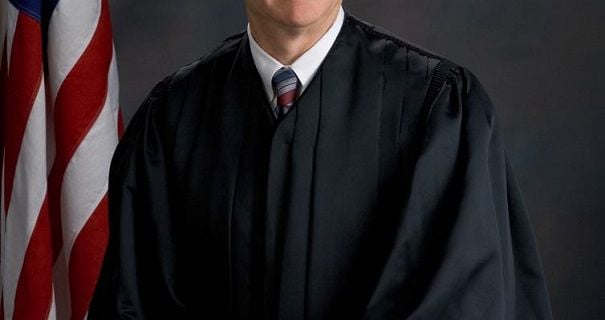
A formal judicial misconduct complaint has been filed naming two federal judges in Minnesota who granted interviews to the New York Times and confirmed a scheme for the judiciary there to “unethically” conspire “to sabotage the president’s lawful immigration enforcement.”
The charges are coming from the Article II Project and its founder, Mike Davis.
Accused are Patrick Schiltz and John Tunheim, both federal judges in Minnesota.
Davis is urging the Eighth Circuit Judicial Council to investigate and remove the judges for their actions.
“The Article III Project just filed a judicial misconduct complaint against Minnesota federal judges who are conspiring to sabotage the President’s immigration enforcement—and bragging about it to the New York Times,” Davis explained.
The complaint notes, “Senior United States District Judges Patrick Schiltz and John Tunheim of the United States District Court for the District of Minnesota made statements that reasonably call into question their impartiality as to the administration, a party that regularly appears before them. […] Canon 2A of the Code of Conduct for United States Judges dictates that ‘[a] judge should . . . act in a manner that promotes public confidence in the integrity and impartiality of the judiciary.’ […] An investigation by the Judicial Council is warranted, and Judges Schiltz and Tunheim should retract the statements to correct the appearance of impartiality that has arisen as a result of interviews that never should have occurred, and they should be removed from immigration-related cases going forward.”
WorldNetDaily had reported that several federal judges in Minnesota, in an article that appeared in the New York Times Sept. 17, admitted coordinating their immigration case decisions.
The result is that there now are “questions over whether the judges were colluding” on responses to Trump administration immigration policies, or “simply sharing expertise.”
A report at Fox News explained, further, that there are additional questions about whether judges should be recusing themselves from cases because of their public comments about an issue that’s ongoing.
Fox reported, “Federal judges in Minnesota tasked with deciding a flood of habeas petitions challenging the detention of immigrants swept up during President Donald Trump’s Operation Metro Surge weren’t working entirely on their own — behind the scenes, they were regularly consulting one another through running email threads and developing tools to quickly handle recurring legal questions.”
The coordinated campaign was revealed by the New York Times which reported there were regular meetings, running email threads, even a spreadsheet created by clerks showing which judges to turn to for detention disputes.
If federal judges are colluding “to thwart legal proceedings related to immigration,” impeachment is not only warranted, but imperative. https://t.co/st0k85O9xb
— Mike Lee (@BasedMikeLee) September 17, 2026
Federal judges are supposed to decide cases independently. In Minnesota, judges handling separate immigration cases were also communicating behind the scenes.
The bench reportedly used meetings, running email threads, an informal spreadsheet and order templates while confronting…
— Erik Hoffmann (@TheErikHoffmann) September 18, 2026
Federal Judges in Minnesota have now been found to be colluding with one another to block Trump’s deportation policies…
This is not justice! This is nothing less than activism in their black robes!
— Hunter Eagleman™ (@Hunter_Eagleman) September 18, 2026
“The idea of a running email chain involving a variety of cases — it strikes me as very weird and frankly unprecedented,” Robert Luther III, a professor at George Mason University’s Antonin Scalia Law School whose work includes federal courts and judicial ethics, told Fox News Digital.
Consultation among judges in common, he confirmed, but each judge ultimately is responsible for independently deciding cases.
That, Luther said, makes the coordination an issue.
The report noted Department of Homeland Security General Counsel James Percival reacted with an accusation that the former chief judge who led the district during Metro Surge “essentially” conspired “with his judicial colleagues” to thwart federal immigration enforcement.
The Department of Justice wondered why sitting judges gave extensive on-the-record interviews about their experience with the administration’s immigration operations, which continue.
Seven of the judges in the district agreed to talk to the Times about their cases, including Schiltz, the report said.
He complained that what happened in Minnesota was “a grave threat to the rule of law.”
A DOJ official told Fox, “It is remarkable that sitting federal judges are giving on-the-record interviews attacking this Administration’s policies rather than ruling from the bench. If judges followed the law in adjudicating cases, there wouldn’t be an ‘overwhelming’ habeas caseload. Judges who have made public comments on pending or related matters should consider whether recusal is warranted going forward.”