
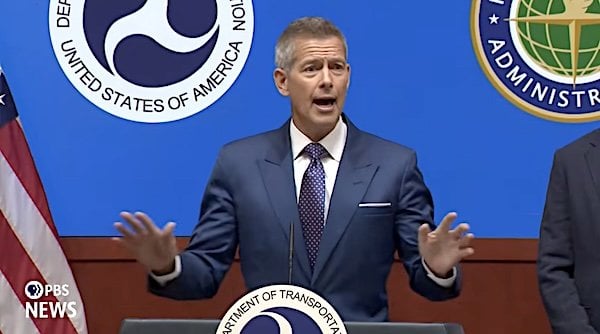
Transportation Secretary Sean Duffy is asking Congress for $50 billion more to rebuild the nation’s air traffic control system, four times what lawmakers appropriated last year.
The federal auditor who reviewed the modernization program says it is unclear what analysis sits behind that number or what the overhaul already underway will ultimately cost.
Together with the $12.5 billion Congress has already provided, the larger request would put the total at about $62.5 billion, or about $182 for every person in the country, based on Census Bureau population figures.
Duffy pressed the case on the Sunday shows and again Monday morning on CNBC. He said Friday’s nationwide ground stop began when a router flooded the network during telecommunications work at an FAA site in Arkansas. The outage and the travel disruptions that followed produced more than 18,500 flight cancellations by Monday morning, according to FlightAware data.
“All I need is the money to finish it,” Duffy said on CNN’s “State of the Union.” Asked on CBS’ “Face the Nation” whether $50 billion was the total ask, he said yes.
Marc Scribner, a senior transportation policy analyst at the Reason Foundation, said the $50 billion is not a documented number.
“They’re going to ask for the highest plausible number and take whatever they can get,” he told The Center Square.
A September Government Accountability Office audit found FAA has no comprehensive, well-documented estimate of what the overhaul will cost taxpayers. The agency gave auditors a high-level figure of $10.6 billion for the first phase but could not produce the analysis behind it. GAO noted the estimate leaves out government labor, most long-term operations and maintenance and all of a second phase FAA estimates will need about $10.2 billion more.
Kevin Walsh, the GAO director who oversaw the audit, said the uncertainty extends to money Congress has already approved and to what is being asked for now.
“There’s not a lot of certainty for what they already have,” Walsh told The Center Square. He said the same is true of the additional money, “whether it’s the $10 billion additional for phase two that we reported in our report, or I’ve seen the secretary asking for 30 or perhaps even $50 billion. It’s unclear how much support or analysis is behind those numbers.”
House Appropriations ranking member Rosa DeLauro, D-Conn., and Transportation subcommittee ranking member James Clyburn, D-S.C., said Sunday that $9.1 billion of the $12.5 billion remains unspent. They did not further define the figure, and called on Duffy to submit a justification to the committee.
“Recent events are not the result of a lack of funding or support from this Congress,” Clyburn said.
GAO reported FAA had obligated $1.8 billion of the $9 billion set aside for systems modernization as of March 2026.
Congress appropriated the $12.5 billion in July 2025 in Public Law 119-21, known as the One Big Beautiful Bill Act. About $9 billion went to systems modernization and the rest to facilities. The systems money included $4.75 billion for “telecommunications infrastructure modernization and systems upgrades,” the largest single line in Section 40003.
Duffy said Sunday on CBS that he has no money for a new telecom system or for software. On CNBC Monday morning, he put it differently: “I do have money to switch over from the old copper wires to fiber, and we’re 70% completed with that mission. But we need a brand new architecture for our telecom in aviation.”
Duffy said on CNBC that the money does not cover the replacement network, FAA Enterprise Network Services. The administration requested $700 million for it in its fiscal 2027 budget request, according to the GAO audit.
The White House Office of Communications said in a statement Sunday that the $12.5 billion was written for radar, radios and related upgrades, not a telecom network or software. The section appropriating the money does not name radios, and it designates $4.75 billion for telecommunications. Duffy’s position is that the money covers upgrades to the existing network, not the new architecture he wants to build. The White House referred questions to the Transportation Department, which did not respond.
Duffy said on CNBC that the ground stop cost “in the billions of dollars,” though he added that he did not have a calculation. The brokerage Bernstein estimated the hit to American, Delta, United and Southwest at about $345 million pretax, with a range of about $270 million to $430 million.
FAA’s public dashboard, with figures posted as of Oct. 15, shows the agency has deployed 15 of 612 new radars, about 2%, against the $3 billion the law set aside for radar replacement. It has installed none of the 435 Enterprise Information Display Systems it plans to deploy. FAA aims to finish all of it by December 2028, according to the GAO audit.
Walsh said that deadline is hard to assess because FAA still has no integrated master schedule, running 11,389 separate project schedules instead. Without one, he said, crews can take down a site that serves as another site’s backup, and there is no way to tell which delays matter.
“They’re buying speed at the risk of cost uncertainty,” he said.
Walsh said the acceleration is warranted. FAA had been taking six to 10 years to modernize individual systems, he said, and the new effort moves delivery of voice radios and switches up by about nine years, from 2037 to 2028. Grounding the national airspace Friday was the responsible call when the agency could not guarantee safety, he said.
Chris Sununu, president and CEO of Airlines for America, the trade group for the major U.S. airlines, said on CNBC that the money would not have prevented Friday’s failure. He urged Congress to approve it anyway, calling $50 billion a bargain at less than 1% of what the federal government spends in a year, for infrastructure that lasts a decade.
This story originally appeared in The Center Square.

