

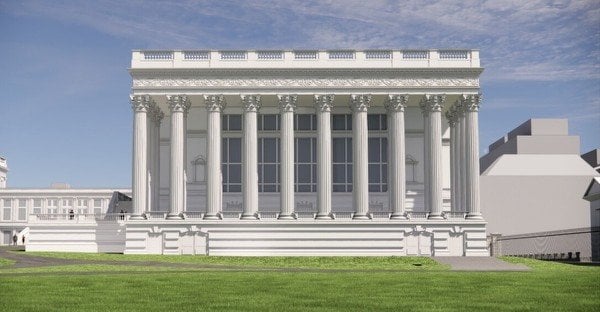
The U.S. Supreme Court decided Monday that President Trump can continue his “home improvement” project at the White House, a massive 90,000-square-foot ballroom taking shape on the east side of the residence and which has been the subject of multiple lawsuits.
By the narrowest of votes, 5 to 4, with Chief Justice John Roberts siding with the three traditionally left-leaning members, the court allowed construction to continue, ruling that the entity that took action to stop the project, the National Trust for Historic Preservation in the United States, lacks “Article III standing to challenge the project in federal court and that the remaining stay factors favor relief.”
The court had decided to step into the ballroom fight Aug. 21, issuing the initial stay and allowing construction to continue until the case could be examined more fully.
In the initial ruling by the D.C. Court of Appeals, judges claimed it was Congress and not the Executive Branch that holds charge over the modification of federal property.
A week prior to the Aug. 21 stay, U.S. Solicitor General D. John Sauer highlighted the project’s national security element in an emergency petition to the Supreme Court.
“This case involves an extraordinary and unlawful injunction that will halt the ongoing construction of the integrated military complex, including a totally secure ballroom space, at the East Wing of the White House, which is vitally required by national security,” Sauer wrote.
He went on to warn that, if the appellate court’s block was permitted to take effect, it “would wrongfully install a single district judge as sole arbiter of what further construction is ‘strictly necessary’ to protect the safety of the President, his family, staff members, and visitors to the White House, including foreign dignitaries, and presidents and prime ministers of other countries.”
Since the ballroom’s initial inception, the national security element has taken more of the White House emphasis, pointing out the need for a subterranean bunker and rooftop drone port available for the U.S. military. Exhibit 1 was the attempted assassination of Trump at the White House Correspondents Dinner last April at a local ballroom, in the Washington Hilton, that lacked tight security.
Trump announced the project in the summer of 2025, accompanied by the immediate razing of the East Wing to make room for the building.
“For 150 years, Presidents, Administrations, and White House Staff have longed for a large event space on the White House complex that can hold substantially more guests than currently allowed. President Donald J. Trump has expressed his commitment to solving this problem on behalf of future Administrations and the American people,” the Trump White House said at the time.
Trump has consistently emphasized that the ballroom itself will be paid for with outside donations and not taxpayer funds and called those who brought the lawsuit “treasonists.”
In dissenting, Roberts opined that the ballroom construction is “likely unlawful.”
Trump responded to the ruling in a post later Monday, saying the project will be built “without any further contingency, doubt, or threat.”
“I am pleased to report that the United States Supreme Court has just ruled in favor of the Ballroom/Military Complex being built without any further contingency, doubt, or threat. We are living in the Golden Age of America, and this Building will be one of the Greatest ever… pic.twitter.com/73zKQku6Ki
— The White House (@WhiteHouse) August 31, 2026
‘UNHINGED!’ D.A. insists White House ballroom will be blown up at ‘official ceremony’
Ballroom fight erupts with claims opponents are ‘treasonists’


